

Applications:
|
|
Features:
|
|
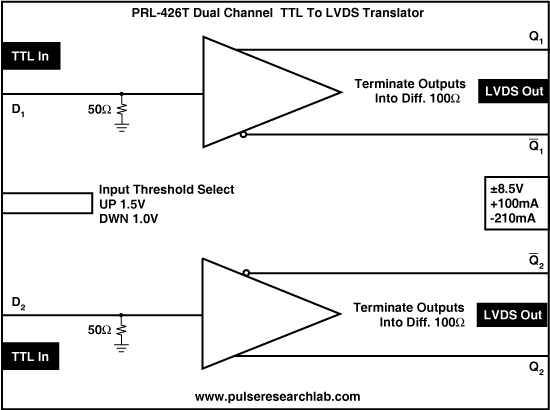
DescriptionThe PRL-426T is a TTL-to-LVDS Logic Level Translator. The PRL-426T input is single-ended, and a toggle switch controls the input threshold (1.5 V or 1.0 V into 50 Ω). The input connectors on the PRL-426T are BNC. The differential outputs are 50 Ω back-terminated and are designed for driving floating 100 Ω loads, normally the configuration used in LVDS input circuits. The output swing is typically 600 mV with a common mode voltage of 1.2 V. Models with the "TR" suffix, e.g. PRL-426TTR, have Triax output connectors instead of the SMA connectors. These high speed translators facilitate testing of high speed digital communications circuits where conversion of TTL clock and data signals to LVDS level signals is often required. The PRL-426T is designed to interface with TTL circuits. In cases where the signal source cannot drive TTL voltages into 50 Ω, the input threshold switch can be used to lower the triggering voltage to 1.0 V. Each unit is supplied with a ±8.5 V/1.8 A AC/DC Adaptor and housed in a 1.3 x 2.9 x 3.9-in. extruded aluminum enclosure. Available accessories include voltage distribution modules for mounting multiple units. |

(0° C ≤ TA ≤ 35° C)*
| Symbol | Parameter | PRL-426T | UNIT | ||
|---|---|---|---|---|---|
| Min | Typ | Max | |||
| RIN | Input Resistance | 49.5 | 50 | 50.5 | Ω |
| ROUT | Output Resistance | 49.5 | 50 | 50.5 | Ω |
| VTOSH | Input Threshold Voltage (high) | 1.4 | 1.5 | 1.6 | V |
| VTOSL | Input Threshold Voltage (low) | 0.9 | 1.0 | 1.1 | V |
| VIL | TTL input Low Level | -0.5 | 0.0 | 0.5 | V |
| VOL | Output Low Level | 0.9 | V | ||
| VOH | Output High Level | 1.5 | V | ||
| VCMV | Common Mode Voltage1 | 1.2 | V | ||
| IDC1 | DC Input Current, +8.5 V | 100 | 110 | mA | |
| IDC1 | DC Input Current, -8.5 V | -205 | -215 | mA | |
| VDC | DC Input Voltage | ±7.5 | ±8.5 | ±12 | V |
| VAC | AC/DC Adapter Input Voltage | 103 | 115 | 127 | V |
| tPLH | Propagation Delay to output ↑ | 2 | ns | ||
| tPHL | Propagation Delay to output ↓ | 2 | ns | ||
| tr/tf | Rise/Fall Times2 (10%-90%) | 1.00 | 1.25 | ns | |
| tSKEW | Skew between any two outputs | 200 | 500 | ps | |
| fMAX | Maximum Clock Frequency | 250 | 300 | MHz | |
| Size | 1.3 x 2.9 x 3.9 | in. | |||
| Weight, excluding AC adapter | 7 | Oz | |||
| Shipping weight, including AC adapter | 4 | lb. | |||
Notes:
(1) VCMV = (VOH-VOL)/2
(2) Rise and Fall times are measured with SMA output connector units only and with ground-referenced 50 Ω loads.
(3) fmax is measured using a PRL-425N with the corresponding input connectors as the receiver. The NECL outputs of the PRL-425N are measured. fmax for the PRL-426T is currently limited by the lack of high frequency TTL drivers.
Units with the Trompeter CBBJR79 Triax ouput connectors are tested using the PRL-425NTR, Universal Differential Receiver (Triax) with Differential NECL outputs, and the Trompeter PCGOW10PCG-36 shielded twisted pair cables.
All PRL products with Triax connectors use Trompeter P/N CBBJR79, Right Angle Circuit Board Bulkhead Jack, 3-lug (Numbered page 10, document page 11 of 142). Any Trompeter 70-series Triax Cable Plug with 3 lugs (e.g. PL75-9, 3-lug) will mate with CBBJR79.

While we believe these models to be accurate, no representations are made as to accuracy or suitability for any application:
PRL-426T: