
Avionics and Telemetry

PRL line drivers, receivers, and fanout buffers are used by aircraft manufacturers, contractors, spaceports, and airbases around the world for flight test, avionics integration, telemetry buffering and translation. Our differential buffers can transmit signals as far as 200' at up to 300 MHz, while immunizing the signal from noise and/or ground potential mismatches. Single-ended TTL buffers can drive up to 100' of cable at 85 MHz. Fanout buffers can drive several units from a single source, including conversion from high-impedance to 50 Ω drive capability.
Differential Buffering:
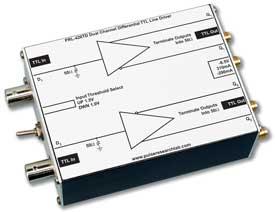
Our most common avionics/telemetry application is conversion of a single-ended signal to differential, for more robust transmission through noisy and/or long transmission paths. The differential signaling rejects common mode noise and accommodates minor differences in ground potential between driver and receiver. In many cases conversion back to single-ended is required as well, and can be accomplished with a matching receiver. Popular models include:
- PRL-420TD, 2 Ch., TTL to differential TTL
- PRL-420RS, 2 Ch., TTL to RS-422
- PRL-426T, 2 Ch., TTL to LVDS
- PRL-420ND, 2 Ch., TTL to differential ECL
- PRL-430AN, 2 Ch., single/differential ECL line driver
- PRL-425T, 2 Ch., Universal Differential Receiver with TTL outputs
More models are available on the Line Drivers and Translators pages.

50 Ohm Conversion:
Another popular application is conversion of signals to drive 50 Ω loads. Many signal sources will not drive 50 Ω loads, will not drive long 50 Ω cables, or will suffer from signal reflections when driving long cables into high-impedance loads. PRL line drivers are designed for driving 50 Ω cables and loads, and they included 50 Ω back-termination for absorbing reflections from high-impedance receivers. Popular models include:
- PRL-444, 4 Ch., TTL/CMOS Line Driver with High Input Impedance
- PRL-414B, 1:4 TTL/CMOS Fanout Line Driver with 1 kΩ/50 Ω selectable input
A complete list of models is available on Line Drivers page.
Signal Fanout: 

Test environments commonly require a single signal source to drive to multiple receivers, such as the UUT, logic analyzers, oscilloscopes, etc. Fanout buffers are different from RF splitters (even active splitters) because fanout buffers regenerate clean logic signals. Popular models include:
- PRL-414B, 1:4 TTL Fanout Buffer, 130 MHz
- PRL-424LV, 1:4 LVDS Fanout Buffer, 1.25 GHz
- PRL-434A, 1:4 NECL Fanout Buffer, 4+ GHz
- PRL-434LP, 1:4 LVPECL Fanout Buffer, 4+ GHz
A complete list of models is available on Fanout Buffers page.